


Disclaimer: For Professional Clients only. This document is provided for information purposes only and does not constitute investment advice, an offer, or a solicitation to invest in any financial instrument or fund. The views expressed are subject to change and should not be relied upon for investment decisions. Certain statements may include forward-looking views which are subject to risks and uncertainties. Triton may maintain positions in the assets or protocols discussed. References to protocols, venues, or tokens are for illustrative purposes only and do not constitute recommendations or indications of current or future portfolio positioning. Triton Limited is incorporated in the Abu Dhabi Global Market (“ADGM”) and is authorised and regulated by the Financial Services Regulatory Authority (“FSRA”) under Financial Services Permission number 240017.
TL;DR
On August 14, we published a well-timed thesis on the Liquidity Pivot. After the Treasury decision from last Wednesday to at least double the size of bond buybacks, two of the points from that piece have been fulfilled and led to a price expansion across crypto assets.
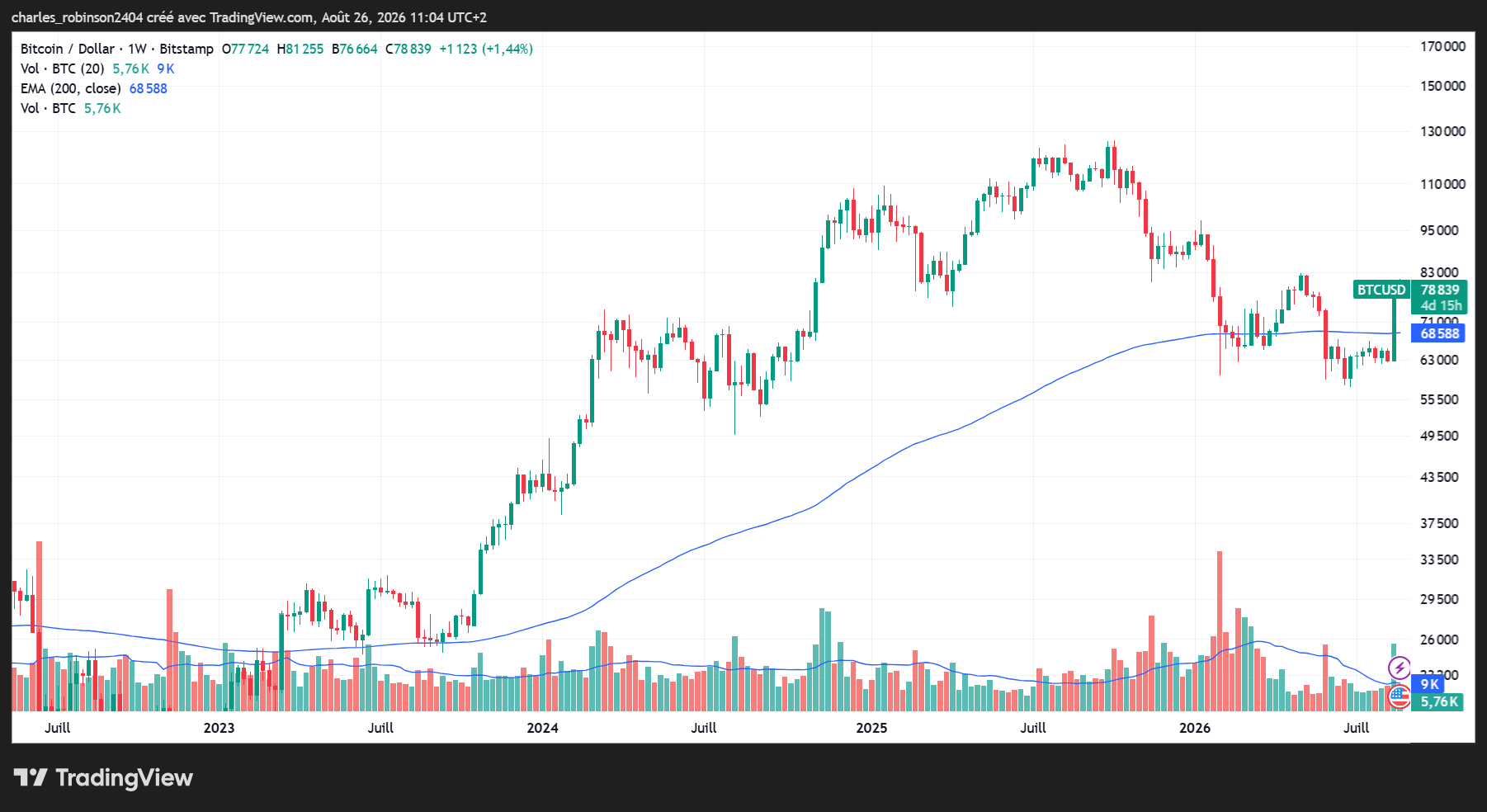
As of August 25, Bitcoin is up +27.2%, rallying from roughly $64,700 to a fresh high near $80,600. The move has broadened well beyond BTC: Ethereum is up +32.6%, Solana has gained +26.6%, Hyperliquid has surged +38.7%, and XRP is the standout of the cohort, up +48.1% over the same window. This is a market-wide risk-on repricing consistent with a genuine shift in liquidity conditions.
Looking back, a couple of the threads we pulled on in that piece have held up well:
The "QE Lite" liquidity-intervention call. We had suggested that a "QE Lite" liquidity regime might be forming via active government intervention in funding markets, not full quantitative easing, but a possible early signal of renewed dollar liquidity expansion, and that moves like this can sometimes precede more aggressive liquidity measures once market stress builds. The specific channel we pointed to (yen/FIMA intervention) wasn't ultimately what moved markets; instead, it was Bessent's decision to double long-term bond buybacks from $2 billion to $4 billion that appears to have been the trigger, contributing to roughly $3 billion in short-position liquidations and helping push BTC through $69,000 and on toward $80,000+ in the days that followed. The precise mechanism shifted, but the broader instinct, that intervention aimed at managing yields would matter for risk assets, pointed in the right direction.
The "asymmetric setup" at the 200-week moving average. We flagged BTC's position at ~$63,900, sitting almost exactly on its 200-week moving average with neutral RSI and no strong directional signal, as a reasonably asymmetric setup, a case for positioning ahead of a potential move rather than chasing one, with an explicit invalidation trigger (a monthly close below that level) that was never breached. That level held, and the rally that followed lines up with the setup we described at the time: technical commentary in the following week noted BTC breaking above the convergence of long-term bear/bull trendlines and completing an inverse head-and-shoulders pattern that had been forming for months.
The Broader Backdrop: A Goldilocks Setup, With a Twist
The Treasury-driven rally we've described did not happen in a vacuum, it landed on top of an already constructive macro picture, which helps explain why the move has had the legs to broaden across the crypto complex rather than fading as a single-day spike.
On the growth side, the data has been unambiguously strong. The ISM Manufacturing PMI registered at 55.6% in July, the highest reading since May 2022, and marked the twenty-first consecutive month of overall economic expansion.
Earnings have told a similar story: at the recent peak of Q2 2026 reporting season, the S&P 500 was on pace for its highest year-over-year earnings growth rate since Q2 2021, with the blended growth rate running as high as 32% even after stripping out the outsized contributions from Alphabet and Amazon.
Under normal circumstances, growth and earnings this strong would typically force the Fed's hand toward tightening, as a hot economy risks feeding through into wage and price pressure. That has not happened this cycle in the way textbooks would predict. Checking Polymarket pricing (as of August 25) for the September FOMC decision, the market assigns roughly a 68% probability to no change in rates, with the remaining balance mostly concentrated on a hike — a market that has, if anything, drifted toward pricing out aggressive tightening even as growth data has stayed firm. Softer core inflation prints over the past two months have created room for that view, and the one component keeping headline inflation elevated - energy - is arguably an external shock rather than a demand-side problem. Our own data confirms this: WTI has traded in a $77-$88 range over the past three weeks, versus a pre-conflict base in the low-to-mid $70s, a premium directly attributable to the ongoing Strait of Hormuz disruption rather than domestic economic overheating.
This combination of strong growth, contained core inflation, and a Fed under no urgent pressure to hike is the setup some market commentators have described as a "Goldilocks" backdrop for risk assets. Where it becomes directly relevant to our Liquidity Pivot thesis is the bond market angle: because long-dated Treasury yields have been under pressure independent of Fed policy, it is Treasury-side intervention (buybacks, and potentially yield-curve-adjacent tools down the line) rather than rate cuts that has become the active liquidity lever. That is precisely the mechanism we described in the original piece, and it is also the mechanism that reopened the door for Bitcoin, Ethereum, and the broader crypto complex to participate in a rally that, until last Wednesday, had largely been the domain of equities and AI-linked names.
Risk On
Taken together, the case for leaning risk-on in crypto is no longer purely thematic. It is now supported by a confluence of confirmed catalysts. Policymakers are actively intervening to manage borrowing costs, and that intervention rather than the Fed's policy rate has become the marginal driver of risk-asset performance. This alone would be a reasonable basis for increased conviction.
But the intervention is landing on top of a genuinely constructive macro backdrop:
This is the rare setup where the Fed does not need to choose between growth and price stability, which removes the single biggest overhang that has capped crypto's beta to broader risk assets over the past two years. Crucially, the technical structure across BTC and the majors: a defended 200-week moving average, a completed base pattern, and now a decisive break to fresh highs all corroborates the macro signal rather than contradicting it, which is the alignment we look for before increasing conviction rather than simply reacting to price.
None of this is without risk: a re-escalation in the oil market or a bond market that normalizes without further Treasury support would remove the specific lever driving crypto prices, and both are conditions we are actively monitoring rather than dismissing. But on balance, the evidence currently points toward a liquidity and macro environment that favors continued risk-taking, and we believe the prudent stance from here is to stay allocated, stay diversified across the assets best positioned to benefit from a renewed debasement trade, and treat further volatility as an opportunity to add rather than a reason to retreat.
If you're an investor interested in gaining exposure to this environment through our strategy, the fund is currently open to new capital. Reach out at chris@tritonliquid.com to schedule a call.

On rare occasions, we publish details on our highest-conviction investments. This week, we revisit our thesis on $GEOD. Our view: GEODNET’s rapidly scaling RTK network and token buyback model make it an underappreciated physical AI infrastructure play.

On rare occasions, we like to publish details on high conviction public-market positions. Galaxy Digital ($GLXY) is one of these. Our thesis rests on three layers; Galaxy’s data center expansion, growing institutional digital-asset business, and emerging compute-futures opportunity.

Treasury’s decision to double bond buybacks to $4B has reinforced the Liquidity Pivot thesis, helping drive a broad crypto repricing. Strong growth, robust earnings, easing core inflation, and limited Fed tightening pressure continue to support the risk-on backdrop, while oil volatility and Treasury support remain key variables.