


Disclaimer: For Professional Clients only. This document is provided for information purposes only and does not constitute investment advice, an offer, or a solicitation to invest in any financial instrument or fund. The views expressed are subject to change and should not be relied upon for investment decisions. Certain statements may include forward-looking views which are subject to risks and uncertainties. Triton may maintain positions in the assets or protocols discussed. References to protocols, venues, or tokens are for illustrative purposes only and do not constitute recommendations or indications of current or future portfolio positioning. Triton Limited is incorporated in the Abu Dhabi Global Market (“ADGM”) and is authorised and regulated by the Financial Services Regulatory Authority (“FSRA”) under Financial Services Permission number 240017.
On rare occasions, we like to revisit one of our existing positions in public form when a fresh, independent voice puts real numbers behind a thesis we've held quietly since August 2024. A few months ago, Kyle Samani, founder of Multicoin Capital, the firm that led all three pre-launch funding rounds in Solana, presented GEODNET as his single pick at the All-In "Best Ideas" pitch competition, sharing a revenue and buyback picture we think most of the market still hasn't priced in. We combine that pitch with our own underwriting below to synthesize and update our investment thesis.
Original Triton piece published January 2025 | As of September 1 | Price ~$0.23 | Circulating market cap ~$102M | FDV ~$222M
TL;DR
GEODNET runs the world's largest real-time kinematic (RTK) network - the infrastructure that corrects GPS from meter-level accuracy down to roughly 2 centimeters, the precision layer underneath drones, autonomous farm equipment, robotic lawnmowers, and increasingly, humanoid and industrial robotics. It built that network in under four years by paying anyone with $600–800 in hardware and a rooftop to run a base station and earn GEOD tokens for doing it.
At current pricing (as of September 1), GEODNET trades at roughly $102M circulating market cap against an annualized revenue of $10.64M, of which 80% is used to buy back and burn GEOD tokens on the open market - visible in real time on Solana. That's a network generating real, growing, subscription-based B2B revenue, from names like John Deere, DJI, and TomTom. Kyle Samani's framing at the pitch competition was blunt: "it's an unbelievably cheap asset... people aren't paying attention because it's crypto bear market right now."
Almost two years since we initiated coverage on GEODNET, the network has grown roughly 3x in station count and 5x in revenue. The thesis has strengthened; the market's attention has not caught up.
The market opportunity
GNSS augmentation services, the correction data layer that makes GPS usable for anything requiring precision, sit inside a global GNSS downstream market the European Union Agency for the Space Programme (EUSPA) estimated at €260B in 2023, projected to more than double to €580B by 2033. Nearly all of that market today is served by capital-intensive, decades-old incumbent networks like Trimble, Hexagon, and Topcon.
GEODNET, founded in 2021 and building its network since 2022, now operates over 21,660 base stations across 171 countries. Coverage extends across roughly 80% of the global population, with dense coverage of every major metro in the US and the substantial majority of rural areas as well.
Why global RTK build-outs keep stalling - and how GEODNET got around it
Every incumbent RTK network was built the way infrastructure has always been built: a company raises or allocates capital, buys land or roof access, installs receivers, and waits years to recoup the capex through subscriptions. That model works in dense, wealthy markets. It breaks down everywhere else - the upfront cost is too high and the customer density too low to justify the capital outlay, which is exactly why coverage gaps persist even in parts of the developed world today, let alone Africa, South America, or Southeast Asia.
GEODNET's answer was to flip who bears the capex. Individual hobbyists, small businesses, and farmers buy the base station hardware themselves for a few hundred dollars, mount it on a roof, and earn GEOD token rewards that offset and eventually exceed the hardware cost. GEODNET's foundation does not need to raise or deploy the capital to build the physical network; it only has to build the software, incentive design, and go-to-market layer on top of a network the community is already building for it.
The business model and token value accrual
GEODNET runs a straightforward two-sided marketplace:
The critical mechanism, and the one Samani's pitch centered on, is what happens to that revenue: 80% of everything GEODNET earns from data customers is used to make open-market purchases of GEOD tokens, which are then burned. The remaining 20% funds engineering and go-to-market. At the current $10.64M annual recurring revenue, that's roughly $8.5M a year in token buybacks - against a market cap of about $102M, a buyback yield of roughly 8.4% before accounting for any revenue growth, and it is all independently verifiable on-chain.
Commercial traction: the part the market is still ignoring
This is where the pitch adds real value on top of our original thesis. By the end of 2024, GEODNET's monthly recurring revenue was around $166K ($2M annualized) and the network was still primarily Polygon-based. As of this month, the network reports:
Samani's pitch added color on customer economics that wasn't public when we wrote the original thesis: new GEODNET enterprise customers spend roughly $60,000 in their first year and ramp to ~$170,000 in year two - a ~3x expansion per account - while the overall customer base grew 5x year-over-year. Named commercial integrations now include:
The network effect logic here mirrors telecom: base-station coverage naturally trends toward monopoly once density passes a threshold, because switching costs for a customer who has integrated a correction data feed are high, and it is very difficult for a competitor to replicate global coverage without replicating the capital structure GEODNET has already avoided.
Team
GEODNET is built by a San Francisco-based team led by CEO Mike Horton, whose background includes a prior successful exit (Crossbow Technologies, sold to Moog for $32M) and CTO roles at ACEINNA and Anello Photonics, both in inertial navigation and GNSS positioning. Co-founder and Head of GNSS, Yudan Yi holds a PhD in Geodetic Science from Ohio State and previously worked on China's largest GNSS correction network - a 4,000+ station buildout backed by Alibaba and state enterprise. David Chen, Head of Web3, is an early crypto participant who first worked on Bitcoin mining ASIC design and then started a public EVM chain.
The team combines deep satellite-navigation domain expertise with hands-on experience building and exiting hardware companies, which is reflected in the capital efficiency of the network build.
The project has raised in four tranches since inception: $1.5M pre-seed (July 2023, Borderless Capital, IoTeX), $3.5M seed (February 2024, North Island Ventures, Road Capital, and others), $2.0M strategic round (April 2024, including Pantera and VanEck), $8.0M strategic round (February 2025, Multicoin Capital, ParaFi, DACM).
Token economics
GEOD is the network's utility and reward token, with a max supply of 1 billion. Circulating supply has grown considerably since our original writeup - from roughly 195M tokens (~20% of max supply) in January 2025 to approximately 462M tokens (~46%) as of September 1, reflecting nearly two years of mining emissions. This is worth sitting with: gross issuance has been heavy, and the buyback mechanism has had real inflation to work against.
The more encouraging recent development is on the supply side of that equation. GEODNET executed its scheduled annual halving July 2026, cutting the base mining reward from 12 to 6 GEOD per station per day. Per current network reporting, the burn rate is trending upward again post-halving, meaning the gap between token issuance (to miners) and token destruction (via the 80% revenue buyback-and-burn) is closing, which is the single most important long-run driver of GEOD's value accrual. Demand-side buybacks that were previously fighting a larger inflation headwind now have a smaller one to overcome.
Governance runs through a DAO (live since May 2024), where veNFTs earned via location NFTs, SuperHex staking, or locked team/investor allocations determine voting weight. There is no equity in this structure - 100% of value accrues to the token, and the GEODNET Foundation (a Singapore non-profit) is contractually bound to the 80% revenue-to-buyback mechanism.
Comparative positioning (as of September 1, 2026)
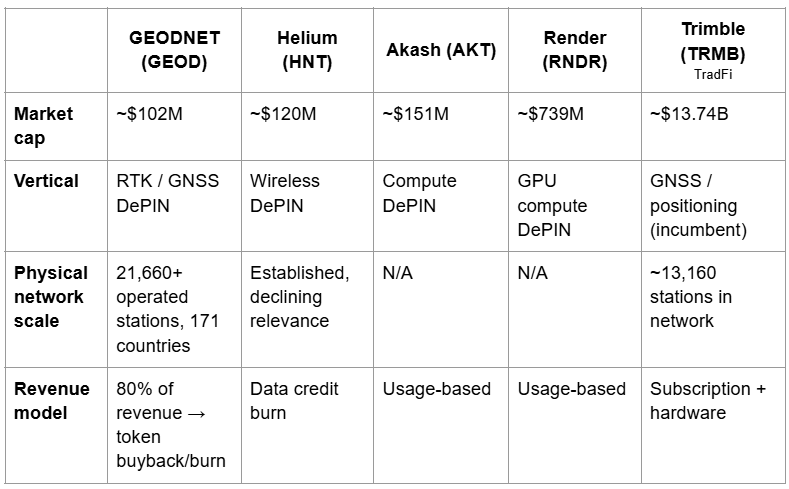
GEODNET ($GEOD)
This note reflects our internal views and modeling assumptions as of September 1, 2026, and should not be construed as investment advice.

On rare occasions, we publish details on our highest-conviction investments. This week, we revisit our thesis on $GEOD. Our view: GEODNET’s rapidly scaling RTK network and token buyback model make it an underappreciated physical AI infrastructure play.

On rare occasions, we like to publish details on high conviction public-market positions. Galaxy Digital ($GLXY) is one of these. Our thesis rests on three layers; Galaxy’s data center expansion, growing institutional digital-asset business, and emerging compute-futures opportunity.

Treasury’s decision to double bond buybacks to $4B has reinforced the Liquidity Pivot thesis, helping drive a broad crypto repricing. Strong growth, robust earnings, easing core inflation, and limited Fed tightening pressure continue to support the risk-on backdrop, while oil volatility and Treasury support remain key variables.