Crypto’s ten-month bear market appears to be entering its late stages, with several structural and on-chain indicators pointing toward capitulation and bottom formation.
U.S.–Japan yen intervention and FIMA mechanics suggest an early shift toward a more liquidity-supportive “QE Lite” environment.
Russia’s new crypto framework adds another structural tailwind by expanding regulated access and legitimizing Bitcoin and Ethereum.
AI-driven credit stress could become a much larger liquidity catalyst in 2027–2028, with Bitcoin potentially front-running that policy response.
The setup supports a gradual redeployment from cash into core positions, led by Bitcoin, with Hyperliquid and Ethereum as additional exposures.
The Thesis
Our thesis rests on four converging pillars:
Market structure suggests the bear market is in its late stages (time-based and supply-based capitulation signals resembling the final months of the 2022 cycle low).
A "QE Lite" liquidity regime is emerging via FX/Treasury intervention mechanics (the Yen/FIMA channel) that, while not yet full quantitative easing, represents the first crack in the door toward renewed dollar liquidity expansion.
Russia's newly signed federal crypto law represents the first instance of a G20-adjacent sovereign economy formally legalizing and structurally institutionalizing crypto ownership and trading - a legitimization catalyst that arrived faster than comparable U.S. legislation.
A slower-burning AI-credit dynamic is building in the background that could force a much larger policy response in 2027–2028 - with Bitcoin historically front-running such regime shifts.
Bitcoin currently trades at $63,906, sitting almost exactly on its 200-week moving average ($63.8k) - a level that has historically marked either a durable floor or a springboard, depending on what follows on the macro side.
1. Where We Are in the Cycle: Market Structure
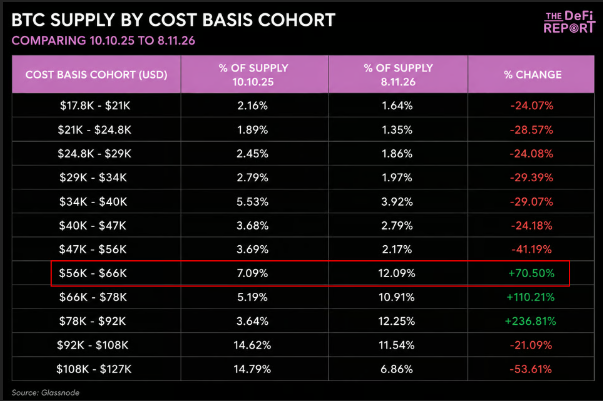
The on-chain supply distribution is telling a story we have seen before. The $56k–$66k cohort - the supply band corresponding to the prior cycle's top - is now the second-largest holder cohort, trailing only the $78k–$92k band (currently holding 12.25% of BTC supply). In 2022, the analogous "prior cycle top" cohort ($17.8k–$21k) doubled its share of supply in the final months of that bear market, pulling coins down from higher-cost cohorts as underwater buyers capitulated. If that pattern repeats, we would expect the $56k–$66k band to continue absorbing supply from the $66k–$92k range above it - consistent with time-based capitulation rather than a fresh leg down driven by new sellers.
Time-in-zone analysis supports the "late stage" reading: BTC spent 105 days in the prior-cycle-top zone during the 2022 bottoming process, with 98% of trading days in the final two months of that bear market spent in that exact band. In the current cycle, BTC has spent 66 days in the equivalent zone - meaningful, though not yet at the 2022 threshold.
Other structural signals reinforce a "late-cycle exhaustion" read rather than a "further leg down" read:
ETF flows have turned positive, albeit weak - suggestive that the heaviest institutional selling pressure has likely passed.
Spot and perpetuals volumes are at their lowest levels since late 2019 - classic low-interest, low-participation bottoming behavior.
Long-term holder supply is declining, consistent with time-based capitulation among holders who aged into the LTH cohort earlier this cycle and are now surrendering.
Miner behavior is stressed: miner selling is running at its highest pace since August 2024, miner BTC balances are at an all-time low (8.9% of supply), and hash rate is down 22% from its October 2025 peak - the steepest hash-rate drawdown of this cycle, exceeding the 16% peak decline seen in 2022. This is consistent with marginal-miner shakeout, historically a late-cycle phenomenon.
Social/search interest remains subdued, below even 2022 bear-market levels - sentiment has not yet re-accelerated, which from a contrarian standpoint is constructive rather than concerning.
Taken together, this points to a market that is roughly 85% through its bear-market drawdown on a time/structure basis, with the remaining move dependent on how the macro backdrop resolves - which is where our attention now turns.
2. The Macro Catalyst: Yen Intervention, FIMA, and "QE Lite"
The most important development of the past two weeks has been the coordinated U.S.–Japan intervention to defend the yen - the first such joint action since 1998. USD/JPY had reached its highest level in roughly 40 years, driven by Japan's negative real rates and the resulting incentive to fund global carry trades in cheap yen. That weakness was itself feeding back into Japanese inflation via import costs, particularly energy (Japan imports approximately 99% of its crude oil), creating a policy problem Tokyo could no longer ignore.
The mechanics matter for our thesis. Japan is the largest foreign holder of U.S. Treasuries. A sustained, large-scale yen-defense campaign risked forcing Japan to sell Treasuries outright to raise the dollars needed to buy yen - precisely the kind of forced-selling event that could destabilize an already-fragile Treasury market. U.S. Treasury participation in the intervention (funded via euro sales rather than dollar sales, to avoid signaling a broader dollar-weakening policy) helped contain that risk in the near term. More importantly, the Fed's FIMA repo facility offers Japan an alternative: pledge Treasuries as collateral for temporary dollar liquidity rather than selling them into the open market.
In his recent article, Arthur Hayes, founder of Bitmex and inventor of the perpetual future, flagged this and explained the scenario in depth:
In "Yen-quake" (Aug 10), Hayes argues the yen has become critically undervalued to the point of creating a political problem for both Washington and Tokyo, and identifies FIMA-facilitated intervention - Japan pledging a portion of its combined $1.373 trillion in Treasury holdings (Japan + GPIF) for dollars, then selling those dollars for yen - as the most likely resolution path, given the alternatives (aggressive BOJ hikes, outright GPIF/MOF asset repatriation) carry greater market-destabilization risk. He notes the facility's current $60 billion per-counterparty cap is likely to rise, citing Treasury Secretary Bessent's own public comments favoring an expansion - and critically, this thesis received real-world confirmation when Japan's Ministry of Finance confirmed it bought yen in coordination with the U.S. Treasury on July 31, with explicit intent to use FIMA going forward.
This dovetails with the source market-structure analysis's own framing: coordinated FX intervention plus the FIMA facility represent a form of "QE Lite" - programs designed to prevent disorderly Treasury selling without yet constituting outright Fed balance-sheet expansion via new Treasury purchases. The FIMA mechanism is explicitly compared to the 2023 BTFP facility rolled out after the Silicon Valley Bank failure: both exist to prevent forced collateral liquidation rather than to actively inject net new liquidity.
Why this matters for positioning: "QE Lite" is not yet QE. It does not remove duration from the market or expand the Fed's balance sheet in the way full quantitative easing would. But it signals a clear directional shift in policy posture - from a hands-off stance toward active intervention to prevent Treasury-market and FX-market disorder. Historically, this kind of shift has preceded, rather than followed, more aggressive liquidity measures once market stress escalates further. We view this as the leading edge of the liquidity cycle turn, not its conclusion.
3. Sovereign Legitimization: Russia's New Crypto Law
A second, structurally distinct catalyst has emerged in parallel with the yen/FIMA story, and we believe it deserves standalone attention in the redeployment thesis: on August 4, 2026, Vladimir Putin signed Federal Law No. 282-FZ, creating Russia's first licensed crypto-trading framework under Bank of Russia supervision, effective September 1, 2026. This is Russia's first comprehensive legal framework for digital assets, and it matters to our thesis for three distinct reasons: legitimization, institutional plumbing, and demand mechanics.
What the law actually does:
Property rights and judicial protection. The law grants judicial protection to digital-currency holders regardless of whether they had previously declared those assets - a meaningful legal upgrade for an asset class that previously existed in Russia in a regulatory gray zone.
Licensed institutional infrastructure. The law creates a licensed framework under the Bank of Russia covering exchanges, brokers, custodians, and depositories, and crypto exchanges are required to join a "special registry" to operate with a minimum equity requirement of 15 million rubles ($185,200), alongside mandatory participation in a financial-market self-regulatory organization. This is a genuine institutional on-ramp, not a symbolic gesture.
Tiered retail access. Non-qualified investors - about 98% of Russian investors, according to the Central Bank - face an annual purchase cap of roughly $3,700–$3,840 per intermediary after passing a suitability test, while qualified investors face no such limit. The retail cap is a deliberate risk-containment measure, not evidence of policy hesitancy - it mirrors how many developed markets phase in access to novel asset classes.
A real, if legally contested, cross-border settlement channel. Domestic crypto payments remain fully banned; cross-border trade settlements are carved out, with no amount cap, as an explicit sanctions-evasion off-ramp for exporters and importers. Importantly, the law explicitly states it does not override foreign sanctions, and U.S. secondary sanctions still apply to blocked Russian entities - so this is best read as an incremental new use case rather than a wholesale sanctions workaround.
A pending asset whitelist. Bank of Russia proposals currently open for public comment have named Bitcoin, Ethereum, and Tether as the initial assets eligible for trading on regulated domestic exchanges, selected on liquidity, market-cap, and price-history criteria - meaning BTC and ETH are positioned as the flagship beneficiaries of the newly regulated retail and institutional flow once trading begins September 1.
Why we read this as bullish rather than neutral: the significance is less about the size of the initial capital pool (retail caps are deliberately modest) and more about the precedent. The move gives Russia a formal structure for crypto trading and related activities while the United States continues working toward broader digital-asset market legislation - meaning a major global economy has now leapfrogged the U.S. in codifying crypto property rights and licensed market infrastructure at the federal level, even as the U.S. Clarity Act stalls in Congress (see Section 5). This adds to a broadening global mosaic of state-level legitimization - the same directional signal we are tracking in the U.S. regulatory calendar and in the Yen/FIMA intervention - and it specifically channels new, rules-based demand toward Bitcoin and Ethereum as the initial whitelisted assets. We would characterize this as a slow-burn but structurally positive demand-side catalyst rather than an immediate price driver, given the September 1 effective date and the modest retail caps.
4. The Slower-Burning Catalyst: AI Credit and the 2027–2028 Setup
The current ai credit cycle provides the macro scaffolding underneath both the yen/FIMA story and the broader liquidity narrative, and we think it is directly relevant to how we should size and time redeployment:
AI capital expenditure is likely a real-estate/credit story, not an earnings story - hyperscalers are functioning as highly leveraged property developers building physical data-center infrastructure, financed increasingly through debt rather than equity.
The "Jevons' Paradox" bull case (falling compute costs offset by exploding demand) is challenged on the grounds that exponentially improving chip efficiency could let existing infrastructure serve far more compute demand with less power draw, creating a path to physical oversupply even as usage grows.
Mapped to a timeline, this calls for hyperscaler CAPEX growth deceleration to become visible by 2027–2028, with bank and government lending channels continuing to expand into AI even as growth slows - a dynamic he compares to the 2006–2007 period that preceded the 2008 credit crisis.
The resolution mechanism - implicit and potentially explicit government backstops for AI-linked credit, up to and including a Treasury-sponsored SPV leveraging Fed emergency lending powers - would represent a far larger liquidity event than either the current yen/FIMA mechanics or Russia's regulatory move, with Bitcoin cast as the asset that "smells" policy accommodation before it is officially announced.
We treat this as a medium-term (2027) tailwind thesis rather than an immediate catalyst. Its relevance today is that it reinforces the direction of travel: policymakers and sovereign states globally are increasingly oriented toward accommodating, legitimizing, or actively managing crypto and liquidity conditions rather than suppressing them. The Russia law and the yen/FIMA episode are the first visible instances of that instinct; the AI-credit dynamic is the larger one still to play out.
5. Confirming Signal: Gold, Yields, and a Breaking Correlation
Several cross-asset signals corroborate the liquidity-regime shift thesis rather than contradicting it:
Gold has moved from roughly $4,043/oz on August 1 to $4,405/oz on August 11 - a gain of nearly 9% in just ten trading days, with the bulk of the move occurring after August 5–6, closely following the yen intervention. Gold rallying alongside rising Treasury yields is an unusual combination - it typically signals markets pricing in inflation risk, policy-credibility concerns, and fiscal concerns simultaneously, rather than a simple rates-driven move. We view sustained gold strength during a period of intervention-driven "QE Lite" as a leading indicator for the kind of environment that has historically also benefited BTC, once BTC/Gold - a ratio which per current signals appears to have already bottomed for this cycle - resumes its historical tendency to catch up to gold with a lag.
Treasury yields, particularly the 30-year, are pushing to their highest levels in 20 years, driven by a combination of geopolitical/war funding concerns, oil-driven inflation, fiscal deficits, deglobalization pressures, and demographic headwinds. Rising yields into a policy-intervention backdrop is precisely the tension the yen/FIMA mechanics are designed to manage - and a tension that historically gets resolved via more, not less, liquidity accommodation once it becomes acute.
The historically strong inverse relationship between USD/JPY and the Nasdaq - weaker yen, cheaper carry-trade funding, stronger risk assets - has recently broken down, turning slightly positive over the past three months as the Nasdaq has risen even alongside yen strength. We read this as an open question rather than a resolved one: either a durable regime shift is underway (constructive, since it suggests risk assets can rally independent of carry-trade mechanics), or AI-driven earnings strength is temporarily masking the FX relationship, which would leave equities vulnerable to a snap-back once that support fades.
6. Portfolio Positioning: The Case for Beginning to Redeploy
Triton's current allocation - cash, with a long tail of small residual crypto positions - reflects the defensive posture appropriate to a bear market that, on a time/structure basis, appears to be entering its final stages but has not yet definitively bottomed. We do not believe the evidence yet supports a wholesale return to the aggressive net crypto exposure the fund carried earlier in the cycle. It does, however, support beginning a measured redeployment, for the following reasons:
Asymmetric setup at current levels. BTC at $63,906 sits almost exactly on its 200-week moving average ($63.8k) and just below its realized price ($52.7k), short-term holder cost basis ($68.7k), and 200-day moving average ($69.8k). RSI-14 at ~48.6 shows neutral momentum with no strong directional signal either way - meaning we are not chasing a move, but positioning ahead of one.
The liquidity direction of travel has turned. The shift from a hands-off Fed/Treasury posture to active FX/Treasury-market intervention (yen defense, FIMA) is a meaningful change in regime, even if "QE Lite" is not yet full QE.
Regulatory legitimization is broadening globally, not just in the U.S. Russia's law, while retail-capped and payment-restricted domestically, is a concrete step by a major sovereign economy toward formal crypto property rights and licensed market infrastructure - adding to the global mosaic of state-level acceptance, and specifically pre-positioning BTC, ETH, and USDT as the flagship assets for a new regulated retail/institutional channel opening September 1.
Miner and structural capitulation signals are consistent with a market clearing weak hands, not one still working through a fresh downleg.
The U.S. regulatory catalyst calendar gives us a clear near-term risk marker. The Clarity Act's odds of 2026 passage have fallen to 22% on Polymarket, with Congress in recess until mid-September and a critical procedural vote (requiring 60 votes, including at least 7 Democrats) on September 15. Notably, Russia's law now sets a precedent the U.S. Congress may feel pressure to match, though this is a soft, reputational catalyst rather than a mechanical one.
Practical redeployment framework:
Bitcoin remains the anchor position. It is the asset most directly levered to the "QE Lite"/FIMA liquidity thesis, the eventual AI-credit-driven liquidity event, and now also the Russian regulatory on-ramp (as one of the initial whitelisted assets). We favor scaling BTC exposure back toward our previously established 10% target band as cash gets redeployed, doing so in tranches using a monthly-close-above-200WMA framework as an add-on trigger rather than a single price target.
Hyperliquid (HYPE) remains our preferred vehicle for expressing the volatility and macro-stress dimension of this thesis, given its validated track record as a crisis-period volume and revenue beneficiary.
Ethereum merits a fresh look independent of the BTC-anchor thesis. Hayes' RWA/tokenization argument, combined with ETH's inclusion on Russia's proposed initial trading whitelist, gives it two distinct, largely uncorrelated demand catalysts that are not currently reflected in the fund's very small residual ETH position.
The long tail of small residual positions should be reviewed individually for conviction before any new capital is added; redeployment capital should be prioritized toward the core thesis names above rather than averaging down passively across the existing tail.
7. What Would Invalidate This Thesis
A monthly close for BTC below the 200-week moving average ($63.8k), signaling further downside into September rather than base-building.
CPI, PPI, or PCE prints (due this week, tomorrow, and August 26, respectively) coming in materially above expectations, forcing the market to price a September Fed hike more aggressively.
Further, disorderly USD/JPY weakness despite the coordinated intervention, suggesting the FIMA/QE-Lite toolkit is insufficient.
Failure of the Clarity Act's September 15 procedural vote, removing a U.S. regulatory tailwind - though Russia's move would remain a standalone positive independent of U.S. outcomes.
A restrictive Bank of Russia final asset whitelist or delayed implementation past September 1, which would push back the timeline for any incremental Russian-driven demand.
Confirmation that the recent breakdown in the USD/JPY–Nasdaq inverse correlation is being driven purely by concentrated AI-earnings strength rather than a genuine liquidity regime shift.
Conclusion
Triton enters the back half of 2026 from an unusually conservative starting point - mostly cash - after a ten-month bear market that shows multiple markers of late-cycle exhaustion on both structural and on-chain measures. Layered on top of that setup are two concrete, near-term legitimization/liquidity catalysts: the U.S.–Japan yen intervention and FIMA mechanics, and Russia's newly signed federal crypto law - the first comprehensive framework of its kind from a major global economy, which explicitly positions Bitcoin and Ethereum as flagship assets for a new regulated market opening September 1. Further, a larger catalyst on a longer fuse - a maturing AI-credit cycle - could force a much bigger policy response by 2027–2028. None of this constitutes confirmation that the cycle low is definitively behind us. It does, in our judgment, constitute sufficient asymmetry to begin methodically redeploying capital - anchored in Bitcoin, expressed tactically through Hyperliquid's volatility beta, and supplemented with a fresh look at Ethereum - while retaining discipline around the specific technical and macro triggers outlined above.
Key levels to monitor: BTC $52.7k (realized price) / $63.8k (200 WMA) / $68.7k (STH cost basis) / $69.2k (21W MA) / $69.8k (200 DMA). Next catalysts: CPI (today), PPI (tomorrow), PCE (Aug 26), Bank of Russia asset whitelist comment period closes Aug 24, Russia law effective date Sept 1, Clarity Act procedural vote Sept 15.
On rare occasions, we publish details on our highest-conviction investments. This week, we revisit our thesis on $GEOD. Our view: GEODNET’s rapidly scaling RTK network and token buyback model make it an underappreciated physical AI infrastructure play.
On rare occasions, we like to publish details on high conviction public-market positions. Galaxy Digital ($GLXY) is one of these. Our thesis rests on three layers; Galaxy’s data center expansion, growing institutional digital-asset business, and emerging compute-futures opportunity.
Treasury’s decision to double bond buybacks to $4B has reinforced the Liquidity Pivot thesis, helping drive a broad crypto repricing. Strong growth, robust earnings, easing core inflation, and limited Fed tightening pressure continue to support the risk-on backdrop, while oil volatility and Treasury support remain key variables.
Thank you! Your submission has been received!
Oops! Something went wrong while submitting the form.
Triton Limited is incorporated in the Abu Dhabi Global Market (“ADGM”) and is regulated by the Financial Services Regulatory Authority (“FSRA”) under Financial Services Permission number 240017.