


Disclaimer: For Professional Clients only. This document is provided for information purposes only and does not constitute investment advice, an offer, or a solicitation to invest in any financial instrument or fund. The views expressed are subject to change and should not be relied upon for investment decisions. Certain statements may include forward-looking views which are subject to risks and uncertainties. Triton may maintain positions in the assets or protocols discussed. References to protocols, venues, or tokens are for illustrative purposes only and do not constitute recommendations or indications of current or future portfolio positioning. Triton Limited is incorporated in the Abu Dhabi Global Market (“ADGM”) and is authorised and regulated by the Financial Services Regulatory Authority (“FSRA”) under Financial Services Permission number 240017.
Internal research note generated from initial X post by Triton CIO | August 27, 2026
On rare occasions we like to publish details on high conviction public-market positions. Galaxy Digital ($GLXY) is one of these, and following the company's Q2 2026 earnings we have never been more constructive on the name.
As of August 27 | Price ~$25.29 | Market Cap ~$9.89B
TL;DR
Roughly a year ago our CIO conducted an interview with Galaxy's CEO, Mike Novogratz, covering the firm's record Q3 2025 net income of $505M and its rapidly growing AI data center business. That thesis has continued to play out and strengthen over the intervening year, based on the fundamentals we discuss in the below article.
The core of the thesis is that Galaxy's Helios data center campus, anchored by its lease to CoreWeave, is worth materially more than the market is currently ascribing to it, and that it will find an investment-grade tenant for the additional 830MW of power available.
Further to that, the company has established itself as one of, if not the, leading player in Texas data center development expanding its pipeline from 2.5GW of capacity ~16 months ago to over 5.73GW today. This supports a landlord-style valuation framework in the tens to hundreds of billions of equity value. We layer on top of this a digital assets business that is deepening its integration into major financial institutions, and an early-stage but structurally attractive option on the emerging compute-futures market.
Helios: From Phase I Delivery to Phase II Construction
In the interview with Novogratz, we discussed our view that Galaxy's initial 3.5 GW at Helios could be worth approximately $60B in equity value, equivalent to roughly $150 per share at then-current shares outstanding. Over the past year, Galaxy has made material progress toward that outcome, increasing approved power from 800 MW to 1.63 GW and expanding its total power pipeline from 3.5 GW to over 5.73 GW. We expect the company to announce a tenant for the remaining 830 MW of approved Helios II capacity within the next month or so.
Construction progress has kept pace with the leasing story. Galaxy delivered the first 200 MW (133 MW of critical IT) to CoreWeave in Q2 2026, with management stating that Phase I was completed on schedule and on budget. Rent has commenced, and management expects approximately $80M of quarterly lease revenue at EBITDA margins above 90%. That implies at least $320M of annualized revenue and approximately $288M of EBITDA on Phase I alone, or roughly $2.17M of EBITDA per critical-IT MW.
We view the next two catalysts as the most important near-term valuation events:
We believe the market is significantly under-appreciating the second catalyst, which would materially improve the economics of the original 800 MW lease.
Our core case applies a 25x EBITDA multiple, equivalent to a 4% capitalization rate. A conventional real-estate cap rate is normally applied to net operating income rather than EBITDA, but the shorthand is useful given that in recent data center transactions EBITDA and NOI are essentially equivalent, as nearly all costs are passed through to the tenant. We believe a 25x multiple is appropriate given Galaxy's pursuit of an investment-grade tenant and the substantial expansion of its power and site pipeline.
Phase II is already under construction. HITT Contracting has been mobilized since April, earthwork is complete, and structural foundation work has begun; the first Phase II data halls are expected to begin delivery in Q2 2027. Management expects seven of the eight Phase II halls online by the end of 2027, with the final hall in early 2028. Galaxy has also completed a $3.5B senior-secured note offering to finance Phase II, priced at 85% loan-to-cost; we continue to use 80% throughout our long-term model to avoid assuming the most aggressive observed financing terms on every future phase. Management has indicated that its expected Phase III equity requirement is already pre-funded through prior capital planning and anticipated cash generation.
The Approved 1.63 GW Base Case: $49B of Equity Value ($125/share)
For the currently approved Helios capacity, we apply approximately $2.2M of annual EBITDA per critical-IT MW, consistent with demonstrated Phase I economics and comparable high-density data center transactions:
The 830 MW lease matters for more than the incremental EBITDA it would add. Tenant credit quality, parent guarantees, lease duration, escalators, renewal options, and financing terms will determine the multiple applied to Galaxy's entire data center business. Every 100 basis points of interest savings on the projected ~$10.3B of construction debt equates to approximately $103M of annual interest savings, though we view the larger effect as running through the valuation multiple rather than the financing cost itself. The 25x multiple we use is supported by contracted rent, strong tenant credit, long duration, disciplined construction, and a credible path to financing. The next 830 MW lease, together with an improved credit package behind the original 800 MW, represent the most important near-term valuation catalysts.
Pipeline Expansion to 5.73 GW: $152B of Equity Value ($389/share)
Galaxy's Q2 earnings identify approximately 5.73 GW of potential gross power across several stages of development:
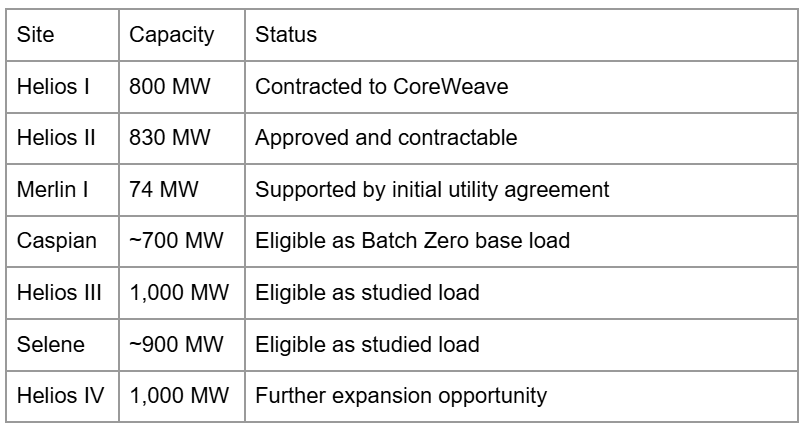
This represents more than a doubling of the power pipeline over roughly eighteen months, and we believe it further reinforces Galaxy's position as a leading data center developer and supports the 25x EBITDA multiple we assign to the business.
For the full pipeline, we apply five consistent assumptions:
The $2.0M assumption is intentionally lower than the ~$2.17M demonstrated in Phase I and the $2.2M used for approved Helios capacity, reflecting a haircut as Galaxy moves into additional sites and brings power online over time. The resulting calculation:
The Equity Takeout Flywheel
An underappreciated element of the thesis is that the ~$9.04B nominal equity requirement for the full pipeline does not necessarily need to be funded through new share issuance. Galaxy has described an equity takeout strategy: build each phase with construction debt and Galaxy equity, stabilize the cash flow, refinance the asset at market value rather than historical cost, return part or all of the original development equity, and redeploy that equity into the next phase.
Galaxy illustrated this mechanism at its December 2025 Analyst Day. In the company's example, a $1B project financed with an $800M construction loan stabilizes at $150M of NOI; capitalized at 7%, this produces approximately $2.1B of value. A 60% loan-to-value permanent financing then raises approximately $1.3B, which repays the original $800M construction loan and returns approximately $500M of equity. Galaxy will also have the option to use cash flows from previously completed sites to fund the equity component of new sites. If this flywheel begins to compound, we believe the power pipeline could double again over the next eighteen months.
Digital Asset Business Momentum
With Bitcoin rallying again and management increasingly constructive on crypto more broadly, we note the recent progress in Galaxy's digital asset business. In Q2 2026, Digital Assets adjusted gross profit increased 34% sequentially to $66M despite weaker digital-asset prices and softer industry activity. Global Markets produced $49M of adjusted gross profit, up 58%, on an average loan book of approximately $1.438B, 1,741 trading counterparties, and approximately $7.1B in combined assets under management and assets under stake. The business spans institutional trading, lending, derivatives, investment banking, staking, asset management, tokenization, self-custody technology, GalaxyOne, and on-chain financing through GOFR.
More significantly, Galaxy is moving deeper into the operating infrastructure of major financial institutions:
We believe these relationships can generate tens to hundreds of millions of dollars in annual recurring revenue through validator fees, platform licensing, managed infrastructure, and asset-management fees, while also creating trading, lending, financing, and advisory opportunities. As an illustrative framework, if Galaxy converts ten to twenty large bank, asset-manager, or custody integrations into $10–25M of annual contracted platform and infrastructure revenue each, that would represent approximately $100–500M of ARR before staking rewards, AUM fees, trading spreads, financing income, or cross-selling. At a 10x multiple, that layer alone could support approximately $1–5B of value, additive to the existing Global Markets, Asset Management, staking, treasury, and venture businesses.
The Hidden Synergy: Compute Futures
We see AI compute futures as a market with the potential to become one of the largest in the world, and believe Galaxy is well positioned to capture a meaningful share of it.
Galaxy Ventures participated in Ornn's $33M seed round. Ornn is building a compute price index, GPU-hour futures and puts, residual value protection, and a spot marketplace for compute capacity. CME has separately announced plans for compute futures based on GPU rental benchmarks, while Ornn is developing products designed to clear through major derivatives venues including ICE. This market is nascent, but the underlying economic need is clear: neoclouds, AI labs, data centers, lenders, and GPU owners are committing hundreds of billions of dollars to hardware whose future rental rates and residual values remain difficult to hedge.
We view this as analogous to the development of power markets, which built spot prices, forward curves, futures, options, basis products, and structured financing around physical delivery. Compute appears to be undergoing a similar transition. Galaxy does not need to own CME or ICE to participate: its Global Markets division could act as dealer, market maker, structured product issuer, lender, financing counterparty, and physical hedger; its data center portfolio could supply real transaction data and natural hedging flow; and its growing institutional client base could supply buyers, sellers, and capital.
Galaxy's investment note on Ornn cites approximately $650B of compute spending in 2026, rising to an estimated $7T by 2030. If a mature derivatives market eventually turns over even three to five times annual physical spending, compute-linked notional volume could reach approximately $21–35T annually — a scale that would place it among the largest commodity and derivatives markets in the world. Galaxy could also bridge compute and energy futures: a neocloud could hedge future GPU-hour prices while Galaxy simultaneously hedges the underlying electricity exposure, positioning Galaxy between the physical power input, the data center rent, the GPU output, and the financial products used to transfer these risks. We would also note that the direct benefit may extend beyond the fee pool itself. A liquid compute forward curve would make future GPU revenue more financeable, potentially lowering interest costs and accelerating the point at which lenders are willing to fund hardware.
Five-Year Outlook
We do not view 5.73 GW as a ceiling. On April 23, 2025, Galaxy disclosed 800 MW of approved Helios power and another 1.7 GW in various stages of load study — approximately 2.5 GW of potential capacity in total. By August 5, 2026, the identified potential pipeline had expanded to approximately 5.73 GW across Helios, Merlin, Caspian, and Selene. That represents approximately 3.23 GW of additional potential capacity, a 129% increase (2.29x expansion), achieved over roughly 469 days (approximately sixteen months) — an annualized absolute pipeline-addition rate of approximately 2.51 GW.
Maintaining this pace for a further five years would add approximately 12.57 GW, producing an identified potential pipeline of approximately 18.30 GW by 2031. Even at half that pace, Galaxy would reach approximately 12.02 GW. At approximately 18.30 GW, applying the same landlord assumptions used above, we calculate:
We present this scenario as a bound on the long-term distribution rather than a base case, given the extended time horizon and the compounding assumptions required to reach it.
Risks
Leasing and credit-enhancement execution risk (High). The bulk of near-term equity value uplift depends on Galaxy successfully leasing the remaining 830 MW at Helios II and securing an improved credit package for the original 800 MW CoreWeave lease. Delay or failure on either catalyst would compress the multiple we apply to the business.
Financing and leverage assumptions (Medium). Our model assumes 80% construction leverage across all future phases, below the 85% loan-to-cost achieved on the recent $3.5B note offering. Actual financing terms, interest rate conditions, and credit spreads for future phases remain uncertain and could alter the equity value math materially in either direction.
Multiple compression risk (Medium). The 25x EBITDA / 4% cap rate assumption underpinning our valuation is predicated on investment-grade tenant credit and long-duration, escalator-bearing leases. A weaker tenant credit profile, shorter lease terms, or a broader repricing of data center cap rates would reduce our valuation materially.
Pipeline conversion risk (Medium). A meaningful share of the 5.73 GW pipeline (Helios III, Selene, Helios IV, Merlin II) remains at the "studied load" or early-stage expansion stage rather than approved or contracted. Conversion of studied load into approved, leased, and constructed capacity is not guaranteed on the timelines assumed.
Compute futures market is nascent (Medium-High). The compute derivatives opportunity discussed above is early-stage, dependent on third-party infrastructure (Ornn, CME, ICE) reaching maturity, and on tokenization platforms achieving scale. We treat this as a call option within the broader thesis rather than a core driver of near-term value.
Digital asset market cyclicality (Medium). The Digital Assets segment remains exposed to crypto price levels and industry activity; the Q2 2026 sequential improvement occurred despite softer conditions, but a sustained downturn in digital asset markets would weigh on this segment's contribution.
Our thesis rests on three layers that we believe are only partially reflected in the current ~$9.89B market capitalization:
What we are watching closely:
This note reflects our internal views and modeling assumptions as of August 27, 2026, and should not be construed as investment advice. Figures relating to Galaxy's operations and disclosures are drawn from company reporting and management commentary referenced above.

On rare occasions, we publish details on our highest-conviction investments. This week, we revisit our thesis on $GEOD. Our view: GEODNET’s rapidly scaling RTK network and token buyback model make it an underappreciated physical AI infrastructure play.

On rare occasions, we like to publish details on high conviction public-market positions. Galaxy Digital ($GLXY) is one of these. Our thesis rests on three layers; Galaxy’s data center expansion, growing institutional digital-asset business, and emerging compute-futures opportunity.

Treasury’s decision to double bond buybacks to $4B has reinforced the Liquidity Pivot thesis, helping drive a broad crypto repricing. Strong growth, robust earnings, easing core inflation, and limited Fed tightening pressure continue to support the risk-on backdrop, while oil volatility and Treasury support remain key variables.